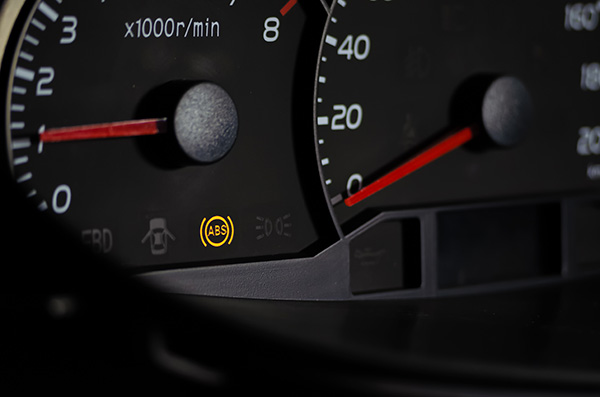
The ABS and traction lights appear together during an ordinary turn. The car still steers, and the brake pedal seems familiar. It's tempting to blame the brakes because one of the lamps says ABS.
The controls share information. Steering angle is one of the inputs they use to understand what the driver is requesting, and a missing or implausible reading sometimes disables related assistance. We'd review the faults and live data before deciding what needs repair.
Why Steering Angle Is Shared With Brake Controls
Electronic stability control compares steering input with the car's actual movement. Wheel speeds and motion readings help complete that picture. When the information agrees, the controls have a reference for normal travel.
A faulty steering angle signal interrupts that comparison. Depending on the vehicle, ABS, traction, or stability warnings sometimes appear together because a related function is unavailable. This combination points to an area to investigate, not a guarantee that the steering sensor has failed.
What the Steering Angle Reading Should Show
We'd watch the live reading while the steering moves through the permitted test. It should respond consistently to the actual position. A signal that jumps, drops out, or freezes needs a different investigation from a smooth reading that is simply offset from straight ahead. The physical wheel position also needs checking. If the steering wheel is crooked after alignment or an impact, the electronic reading needs to be reviewed with the mechanical setup. Teaching a new reference around a displaced steering position leaves the underlying problem unresolved.
ABS Warning Lights Have Other Possible Causes
A wheel-speed sensor, damaged encoder, wiring fault, or shared power problem sometimes brings the same group of lamps. The next step is to compare the inputs rather than replace the first sensor mentioned in a code description.
For example, a wheel-speed reading that drops to zero while the other wheels still report movement directs us toward that wheel's circuit and signal source. An angle reading that disappears while wheel speeds remain believable points elsewhere. Those comparisons are what separate similar warnings into different repair jobs.
Recent Repairs Change Where We'd Start
Tell us if the warning began after:
- Wheel alignment or steering work
- A battery discharge or replacement
- A curb or pothole impact
- Steering-column or airbag-area work
- Replacement of a related control module
- Tire changes followed by new handling behavior
That sequence helps us check something disturbed or left incomplete before assuming a new unrelated failure. It also tells us which calibration instructions and mechanical checks need to be reviewed.
Calibration Sometimes Restores the Reference
A sensor may be sound but no longer have a valid straight-ahead reference, so it may need initialization or calibration. The required process depends on the vehicle and the work performed.
We'd confirm wheel alignment and steering position first, then follow the scan-tool routine or other manufacturer procedure. Some cars relearn under defined conditions; others need a specific setup. Repeatedly turning the wheel lock to lock isn't a universal fix, and calibration won't reconnect a damaged wire.
When Steering Angle Sensor Replacement Is Supported
A failed or damaged sensor needs replacement when the tests support it. This includes checking its supply and ground, connections, and, where applicable, the communication path. A missing reading sometimes begins outside the sensor.
Access also changes the repair. Some sensors share a column assembly, while others are integrated differently. Work near an airbag needs the vehicle's isolation procedure. The estimate should explain the replaced part, any related setup, and the required post-repair verification.
Can You Keep Driving With These Warning Lights?
Read the owner's manual for the exact lamps and messages. An amber assistance warning sometimes means a feature is unavailable even though ordinary braking remains. That changes how much help the car provides on a slippery road or during an abrupt maneuver. A red brake warning, a soft pedal, strong pulling, or a clear steering change means you need to stop safely and arrange assistance. Don't decide the car is fine solely because it completed the last block normally. Describe both the warning and the physical symptoms when calling.
How We'd Check the Repair
The final review needs more than clearing the lamps. We'd confirm the angle reference, watch the relevant readings, and follow the required road-check conditions. The steering wheel and tracking should agree with the electronic information.
If the original warning appeared only after warming up or during a particular steering movement, that pattern needs to be considered in verification. Keep the findings with your service record. If a warning returns, report whether the same conditions triggered it rather than clearing the codes again.
Brake Warning Testing at Loyola Marina Auto Care
Loyola Marina Auto Care in Westchester, CA, can check ABS, traction, and steering-related warnings and compare the readings behind them. Bring details of recent repairs and explain any changes in braking or steering.
Contact Loyola Marina Auto Care to schedule warning-light testing and review the repair based on the results.